
Waking up is hard to do

Why to Wake Up book by Danielle Geva

Productivity articles all seem to insist on waking up early. Their rationale? You’ll be able to focus on important work before the distractions of life demand your attention. This sounds great at 2am, but much less compelling a few hours later when my alarm goes off.

If you’re anything like me, everything’s a blur early in the morning. It’s only after the sun sets that I regain clarity and drive. Then when the world sleeps, I can finally enjoy the peace others experience at 5am.

Luckily, I learned this early about myself and plan my schedule accordingly. The thing is that without early meetings and morning deadlines, sleeping in becomes incredibly tempting. Waking up later is one thing, but lying in bed for hours afterwards isn’t healthy when it becomes a habit.

One morning, I was feeling particularly low and needed as much motivation as possible to get out of bed. I decided to list every random reason to wake up. The only thing more therapeutic than writing is list-making.

The forgotten draft becomes a book

A few years later, I found the forgotten list and couldn’t help but add to it. The simple act of listing reasons to wake up was almost as motivating as the reasons themselves. This time I was determined to share the list with anyone struggling to wake up. However, instead of publishing a blog post, I wanted to publish a book. After constantly encouraging friends to author books, I had inadvertently convinced myself to create one of my own.

Around the same time my favourite illustrators were all working on their own projects. Instead of illustrating for other authors, they were launching books where their beautiful illustrations dominated. This inspired me to turn my list into a book of illustrations. The format was perfect as sleepy readers would have a much easier time with images than pages full of text.

The plan was to write down 50 relatable scenarios. I hit a wall at 30. Instead of wasting time staring at my screen, I stepped away. This may sound like giving up, but it’s far from it. Sitting at a desk stifles creativity, and a change in my surroundings would help me generate new ideas. Refuse to let anyone make you feel guilty about your process. Even yourself.

Over the next few days, I watched downtown commuters rush to work. I imagined their morning routine, and scribbled down notes. I also kept a notepad on my bedside table to document my own mornings (and came up with reason #35 on a weekend). When I returned to my desk to type the notes up, I started with the title. As soon as I typed “Why to Wake Up”, my fingers moved to complete the sentence with obvious reasons I had managed to overlook.

Illustwriting for beginners

Next, each reason became a caption for an illustration. I’ve always felt more comfortable sketching in pencil, because the sketch can evolve and be erased until perfect. This process was useful when figuring out the best way to convey the captions, but resulted in overly complicated drawings. Ultimately, I used pen to create more natural and effortless illustrations.

I came up with even more reasons while sketching, and ended up with 56. Compatible reasons were paired for facing pages, which I then tweaked for a stronger connection. Next, I scanned the illustrations and quickly regretted drawing some too close to the fold of my sketchbook. Any illustrations that couldn’t be saved by the scanner’s settings had to be redone.

It was only after viewing the first draft on several devices that I noticed my rookie mistake. Even though I had meticulously edited each illustration’s bleed-through, their background was still visible against the PDF. I realized that the only solution was to remove their background entirely using Inkscape. The extra work and wait was worth it though, as the transparent background made the book look significantly more polished.

Book formatting is tricky

Quick research revealed that Word isn’t ideal for book formatting. But I decided to ignore the warnings. Learning to overcome Word’s obstacles sounded much better than the recommended alternative. There was no way I was spending weeks searching for, evaluating, and figuring out how to use specialized publishing software.

While Word is fairly tricky to navigate, there are several book templates available online that made it easier. These templates can be used as is, but I used them as guidelines for custom formatting my 6’’ x 6’’ book (the perfect size for any nightstand).

A common complaint with Word concerns its two page view. When you open a book, one written in English that is, the interior cover is on left and the first page is on the right. However, printing shops require separate files for the book’s cover and its content. As a result, Word displays the first page on the left. This is troublesome visually, but also impacts the formatting.

At first, I simply added a blank page to represent the interior cover. This way I could better see the pairs of illustrations and modify their order. Then, I removed the blank page and used odd section breaks to ensure that the title, first illustration, and about author pages were on the right side page. Section breaks also helped keep margins accurate, especially for the larger gutter.

Another issue was switching images. If I deleted an image and imported a new one, then all of the captions would be in the wrong place. I finally discovered the replace image function, which ensured the other elements would remain in their original position. Understanding all of Word’s image settings was essential for a book of illustrations.

Last minute panic

After the content was ready, I created the book’s cover in Inkscape. I wrote a description of the book and a call to action for the back cover, and placed an ISBN and barcode below.

Designing the front cover was much more daunting. Even though I had my heart set on an inception concept from the beginning, I suddenly panicked. I worried that the front cover wouldn’t be legible, and switched to a plain text cover.

Right before printing, I asked a friend for feedback and they urged me to stick with the original cover. I listened to their advice as I realized that the cover of a book should evoke curiosity and entice potential readers. If anyone was confused, they could always find the title and author name clearly printed inside of the book.

Off to the book printers

Once the content and cover were finalized, I saved them as a high resolution PDF by selecting 300 dpi on Adobe Acrobat. All that was left was to pick a printing shop. After doing some research, I decided to contact The Printing House (TPH), TLAC Toronto Printing, and Sure Print & Design in Toronto.

According to reviews, TPH seemed to have hit or miss customer service. However, I was curious to see if their prices were affordable as a large chain. I emailed customer service for a quote, and they quickly replied back asking for my preferred location. I answered and then never heard back. Since the location was pretty close, I stopped by while waiting to hear back from other printing shops. The service was decent, but the price was insanely high. My guess is most of their customers are financial district employees with expense accounts.

TLAC had the most positive reviews on Google, and their customer service still exceeded expectations. While I trust that they would have done a great job printing my book, their quote was too high for my first batch.

Sure Print & Design had fewer reviews, but they were all positive. Their site is by far the most helpful, and they even had an online calculator for instant estimates. Sure Print & Design’s quote was within my budget, and their excellent service won me over.

Finding and deciding on a printing shop took longer than expected, but Sure Print & Design printed and shipped the book in record time. The whole process from inquiry to delivery took only 8 business days. The book itself was flawlessly printed and bound, while the high quality paper looks and feels great.

Waking up is hard to do, but reaching over to grab a physical copy of my first book helps.


Enjoyed this post? Subscribe here!


Projections aren’t goals

Every project needs a clearly defined goal to have any chance of succeeding. Once the goal is set you may know which way to go, but projections will determine how you get there.

Start by setting ambitious goals

Goals are meant to be ambitious. Instead of reminding yourself that ‘low expectations lead to no disappointment’, go with the ‘aim for the moon and land among the stars’ saying. Also, it may be time to surround yourself with more high-achievers.

My latest goal was to publish my first book. I thought that setting a goal around sales would take away from the accomplishment of creating the book. Then the marketer in me reminded the hippie in me that it’s about your intentions. More book sales mean more people enjoying the book. It means covering printing costs and funding future projects. It even means increasing donations and awareness to important causes.

When setting a goal for your project you want to be ambitious yet realistic. J.K. Rowling’s Harry Potter and the Philosopher’s Stone sold over 107 million copies. That’s a great long-term goal for an author, but not a realistic one for my three month timeline. Especially for a book of illustrations. Researching similar illustration books, and focusing on their early sales, is a better route.

projections-arent-goals-danielle-geva-art

Estimate projections based on data

Projections are estimates of how many book sales you expect to generate with various sales and marketing strategies. Best case scenario, you have you own historical data to improve the accuracy of your projections. I don’t. Even though I have nearly decade of marketing consulting to inform my calculations, my experience with self-published books is limited. Along with online research, it’s a good idea to chat with others and learn from their success (and mistakes). This will also help you to breakdown a channel like press into the relevant publications for your audience.

If you’ve heard of quant based marketing, you’re already familiar with working your way backwards. However, this method won’t work unless you understand that projections aren’t goals. Unlike goals, projections aren’t aspirations. You can’t fudge the numbers when the total is lower than your goal. If the numbers don’t add up, you need to keep on researching new strategies to find better ways to reach your goal.

How to use projections to achieve goals

Goals are successfully achieved when you pick strategies based on projections rather than bias. A common trap is picking your favourite strategies despite their low projections. Whether you’re prioritizing your enjoyment or skill, you can’t hope to magically stumble on a tactic that outperforms the projection. The projections are all based on proper execution. Finding the right tactics for each strategy is a given, and your expertise will only ensure there’s less of a difference between the estimate and actual outcome.

You can’t ignore high projections either. It doesn’t matter that podcast ads have a greater reach, or that Instagram ads have a higher conversion rate. The only important metric is the total number of book sales each platform drives. As long as you’re within your budget and timeline, the cost shouldn’t deter you. An expensive strategy that delivers quick results is better slogging away for months with lower returns. This way your time can be better spent on planning a future project to maintain momentum.

to-do-list


Projections can only try to reduce failure

As much data as you may have, projections are still only estimates. A projection doesn’t know that your content marketing strategy will fail because your domain will be down. This reinforces how crucial it is to select the best strategies to mitigate risk. You may miss your target, but you’re still much closer than if you had started with low performing strategies.

Taking the time to make projections can also minimize your losses by making it easy to adapt. If your original content marketing strategy fails, you can repurpose your content. Projections will help you decide if switching to guest blogging is an easy out, or if it will actually be worth it.

Experience fuels future success

Measuring your success if important, even if there is none. Reflecting on how effective you were will help you avoid mistakes and improve the odds of your future success. Once the project is done, you’ll also be able to compare your initial projections with real results. Understanding the cause of the variance, is the key to becoming better at making increasingly accurate projections in the future. You may discover that you can aim even higher, and feel confident about setting bigger goals.

Enjoyed this post? Subscribe here!


An expected twist

The story behind my decanter artwork

Whenever I see decanters, I’m tempted to buy them. They are essentially useless to me, but it’s difficult to resist their beauty and elegance. I try to justify the purchase by imagining other uses for them. Perhaps one could be used to serve water, another to store cotton balls, and a third as a vase. Then I think that flowers belong in the garden, and so I walk away.

It wasn’t until recently that I learned that decanters weren’t simply vessels meant to hold alcohol. One of their functions is to aerate wine. Allowing wine to breathe after being bottled up for years, seems like a fitting metaphor for my journey.

Over the past decade I spent the majority of my time as a marketing consultant. It wouldn’t be accurate to say that my creativity had been bottled up, especially while working with startups, but it has been too long since I’ve created art for the sole purpose of self-expression.

It’s been even longer since I’ve experimented with making something in the physical world.

Art isn’t a new passion. I’ve studied art for over 13 years, and those who are close to me always wondered why I ever stopped. Instead of getting into that, here’s how I got started again.

Whenever I used to have down time, I would log in to Codecademy, read a startup book, or clear my Pocket full of tech and marketing articles. My interests became too narrow. Contrary to popular belief, this isn’t great professionally. The most innovative ideas are the result of exposure to different topics and industries. I asked around for new sources of information, and ended up reading a few long form articles on random topics. This wasn’t enough. The articles opened my eyes to new ideas, but I needed to be more immersed.

I came across a chemical engineering course, and thought about diving in. Chemical engineering is vastly different from anything I’ve studied before. What are the odds that I would have studied engineering had I known about it earlier? Or, would I have known about it earlier had I was better suited to study engineering?

This lead me to wonder about the subjects I already knew about and somehow forgot.

Whenever a friend turns out to be a secretly talented artist, I encourage them to create even more and sell their art online. I tell them how they shouldn’t doubt themselves, and how I wish I could spend my days making art.

Instead of taking random online courses, I decided to rediscover one of my forgotten passions. It felt incredible to dig up my old sketchbook, and buy new art supplies. My curiosity grew, and being an artist no longer felt like a hobby or a crazy retirement dream.

An old sketch inspired me to play with shapes and lines, and the design of the modern decanter made for the perfect subject. The medium was a given. One of the last pieces I created years ago was in oil pastel. All that was left was to listen to my own advice and share the completed artwork.

Enjoyed this post? Subscribe here!


How to Accelerate Community Growth with a Podcast

How to Accelerate Community Growth with a Podcast

Listening to podcasts has quickly become everyone’s favourite new pastime.

Podcasts don’t feel like the result of careful planning by a marketing team. Instead, listeners are the silent participants in a conversation they can’t wait to share with their friends. An emotional connection forms as the host’s voice reaches listeners with unedited discussions and personal stories.

While others compete for eyeballs and are quickly forgotten, you can leverage a podcast to grow an engaged community that will generate positive returns for your business. Here’s how best-in-class marketers are incorporating podcasts into their content mix to accelerate the growth of their community.

Reach podcast fans through existing audio platforms

When deciding on a podcast hosting solution, you should find one that makes it easy to distribute your episodes to podcast listeners. Audio platforms like iTunes, SoundCloud, TuneIn, and Stitcher help podcast fans easily discover and listen to your podcast. These people might have never heard of your company, and now you can reach them every day on their commute.

Plan your distribution strategy before you launch your podcast, as you would for any other piece of content. Understanding how to increase your discoverability on each of these platforms will maximize the reach of each episode. Start by searching for related podcasts to see which ones rank well and learn from best practices.

What keywords are they using in their title and description? How many ratings and reviews do they have? How do they structure their show notes? These are some of the areas you can optimize for better reach.

Continue reading

Beyond the sign up form: 10 places driving new subscribers to Mypodnotes

danielle geva podcast call to action union square

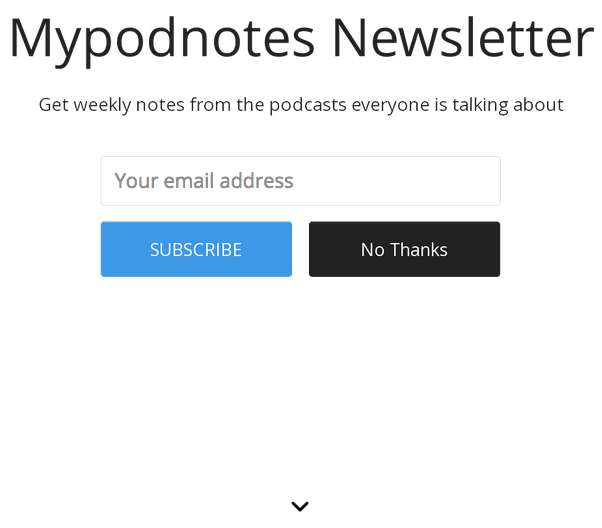
Finding the right call to action for growing my newsletter took a couple of weeks to refine, but I’ve finally settled on the copy. Here’s what I decided to go with:

“Get weekly notes from the podcasts everyone is talking about”

It starts with “Get” because verbs put people in the mood to act. In this case, it encourages them to type in their email and click the subscribe button. The idea of receiving value is also more enticing than a statement about the newsletter’s content.

Then there’s the frequency to set their expectations. People who don’t have time to listen to podcasts are probably too busy for a daily email, so I wanted to eliminate their concern of being bombarded with emails. This is just an assumption, so let me know if you’d prefer to receive a daily email, an email for every new Mypodnotes post, or an email for specific podcasts. (Update: due to popular demand, daily emails are now available. Enjoy!)

The last part of my call to action appeals to people’s fear of missing out, as the final push to motivate them to subscribe. I bet while you were reading “podcasts everyone is talking about”, it immediately triggered a flashback to a podcast recommendation from your friend or a story your coworker heard in an episode you need to hear.

Your call to action might not follow the same formula, and that’s okay. Find what works for your audience by asking friends or an expert copy writer. After you’ve crafted your own call to action, here’s where to get your first email signups.

1. Website Header (Smart Bar or Welcome Mat)

mypodnotes welcome mat

2. Navigation Bar

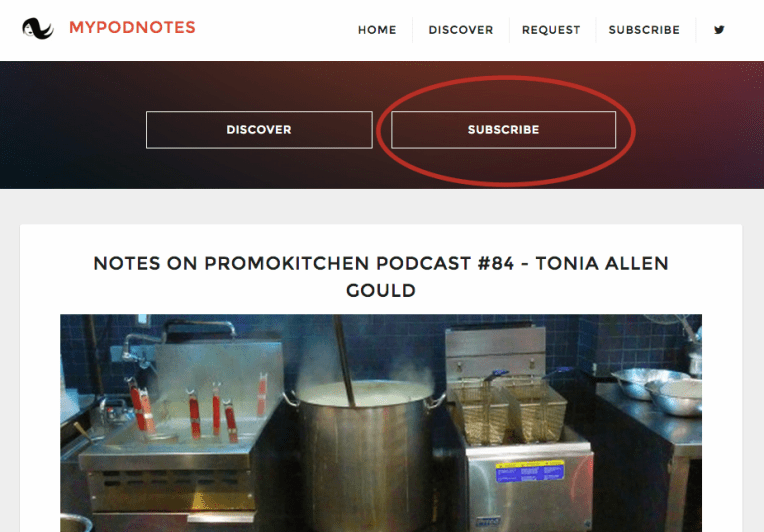
mypodnotes subscribe navigation bar

3. Call to Action Button (Button or Widget)

mypodnotes website button

Continue reading