

Warning Signs

Warning Signs

In this post, I look back on all the clients I said no to and those I should’ve said no to. The thing about bad clients is that sometimes things only take a turn for the worst once you start working together. Whether you notice the warning signs from the get go, or they reveal their true colours later on, all that matter is that as soon as you do it’s time to get out.

Bad Reputation

My favourite way to acquire new clients is through referrals. There’s an instant layer of added trust on both sides. Unless of course that introduction has a hidden message when you read between the lines. Even though they don’t mention anything negative outright, you can tell this potential client is bad. Maybe it’s an introduction from another client that thinks work is work, or maybe it’s from a friend that doesn’t recognize the warning signs. Whether they have have no standards or clue, you do. Explain to them who you’re interested in working with, or stop taking referrals from these people.

Then there’s the client that seems fine, but is complained about by others. Shared contacts start mentioning how the client doesn’t deliver on promises, and that they tend to disappear for weeks. They are hoping to bond over venting, but you just politely nod as you slowly realize how blinded you were. In hindsight, things weren’t going great and it was just a matter of time before you would have a horror story of your own. Now that you see the whole picture, it’s time to leave. Don’t endure a bad client just because others choose to.

The easiest way to avoid this type of client is with proper vetting. You’ll discover if the client has a bad reputation and confirm that it’s based on fact.

Back and Forth Scheduling

When you have trouble scheduling a meeting with a potential client, it’s an indicator of future problems. Does this sound familiar?

Monday – 10am

Client: Let’s meet to chat over the details.

You: How’s Tuesday at 9am over Google Hangouts? I’m also available Tuesday between 2pm – 4pm, Thursday between 9am-11am, and all day Friday.

Client: Let’s do Wednesday at 3pm.

You: Ok, see you then.

Client: Sounds good.  


Wednesday – 3:15pm

You: Hey, are we still meeting?

You: Hello?


These people are the reason there’s a new scheduling app every six months.

This seems insignificant, but if they can’t schedule a simple meeting, how can you expect them to communicate properly when you work together? It’s unbelievable how common this is. These clients also always seem to have tech problems. If the stars align, and somehow you finally meet, their mic will suddenly be broken. Or you’ll wish it was after 5 minutes of listening to: “Can you hear me now?”

Money Over Product

As startups became mainstream, I’ve noticed new grads are turning down jobs to build their own company. As an entrepreneurship major and career-long freelancer, I loved the trend. That is of course until I met with a few of these clients. It seems they didn’t have a burning passion to change the world, they just wanted a slice of the pie. They turned down valuable learning opportunities at other startups because they thought they could make a boat load of money being the boss.

When your client is motivated by money over product, they won’t invest the resources needed to build a sustainable business. They might disguise it as optimizing for profits, but their selfish desires keep them from creating a product that actually solves a problem or adds value. There’s no future working with them, so get out before they start making excuses why your payment is late.

Late Payments

Sometimes you realize payment is going to be an issue before you even start working with the client. Because I blog about consulting, potential clients often reach out with more specific questions. I love learning about their companies and chatting about possible solutions, but some clients take advantage. These clients are typically the ones that go out of their way to reassure you that they are definitely interested in hiring you. They make it seem like they are qualifying you, but in reality they are only interested in getting free advice. If you suspect this is the case, then it’s up to you to move the conversation forward. Let them know you’d be happy to work with them to address their latest batch of questions, and then clearly state the next steps.

Then there are clients that manipulate you into starting work without any intention to pay. In the beginning of the project, both sides agree to the terms. Once you’re done the work you send over the invoice. The payment is late, but you think it’s an honest mistake. After you send a reminder, the client proudly declares that they aren’t going to pay. Whichever loophole they use to justify their awful behaviour proves that they never intended to pay. They’ll try and convince you that it’s your fault, and even suggest you continue working together. If you believe that most people are good, know that this client isn’t. Walk away, and warn others.

Despite these experiences, I try not to be hard on clients that are late with invoices. It can happen unintentionally, and I plan accordingly. The trouble isn’t with consistently late payment, it’s with increasingly late payment. The first time a bad client is late, they may profusely apologize. The more it happens, the more outlandish the excuses become. If you don’t want to wake up one day and realize you haven’t been paid for 6 months, you need to address the situation as soon as it happens. When a client stops paying, you need to stop working. It sounds logical, but it can difficult to do when you care too much about a project. However, all of your hard work won’t be appreciated because when a client doesn’t pay you it means they don’t value you.

Poor Data Quality

When a client doesn’t share the data with you, they are setting you up for failure. Remember when they bragged about their 1 million app downloads? Well, the reality is that the number is irrelevant because they only have a handful of daily active users left. It’s impossible to develop an effective strategy when it’s based on incomplete or poor data. Avoid confusion by first finding out if they are being intentionally dishonest or have trust issues. This way you’ll know if it’s worth moving forward with the client.  

Some clients are legitimately unaware of the importance of key performance indicators. They can’t figure out how to set up Google Analytics, and instead rely on their gut instinct. Try to explain to them the value of accurately measuring your progress. If the client refuses to prioritize proper tracking, then don’t be surprised when they don’t appreciate your hard work. Not only will they dismiss your success, they might also hold you accountable for any of the company’s failures.

Lack of Dedication

There’s no shame in working a day job to support your own business, but beware of clients who struggle to balance the two. If the client is constantly distracted by their demanding day job, they will end up being too burnt out to manage their company. At first they’ll take longer to respond to you, but soon you’ll have to work overtime to correct their mistakes. If the overworked client then accepts a promotion, it’s a clue that they are just happier working for someone else. They might not admit it, but you’ll know it’s time to move on.

Then there’s clients that appear to care about work-life balance, but the truth is they don’t understand the hard work needed to run a business. After you’ve spent months planning and working towards a relaunch, the client casually mentions they won’t be around. No, this isn’t because of a family emergency, or a once in a lifetime opportunity. Instead of responding to customers, fixing bugs, and celebrating milestones together, the client made plans to hang out with friends. Either they don’t have strong work ethic or they don’t care. Don’t stick around to find out which one.

Downright Abusive

The abusive client is reminiscent of a bad ex boyfriend or relative, and once again you can’t help but focus on the good and make excuses for the bad. They only humiliated you in front of their friends because you made a mistake. They only lost their temper because they have been working overtime. This is obviously a deal breaker, yet it’s hard to recognize when it happens to you. Even if you’re convinced they have good intentions, you don’t deserve to be treated this way. If you’re unsure if you’re being abused, imagine how you would react if this happened to your friend. Better yet, share the incidents with a friend to get an objective opinion. Their support will help you banish this recurring character from your life.


You’ve got to surround yourself with good people to thrive, so avoid bad clients by paying attention to these warning signs.


Enjoyed this post? Subscribe here!

Why you won’t get paid

Danielle Geva - Why you won’t get paid

Freelancing lessons better learned shaving someone else’s beard.

The oral contract

On legal shows, an oral contract is enough to win a case. In real life, the client knows you’re not going to sue them. A conversation about consulting terms leaves plenty of room for loopholes. The client takes advantage of you, claims it was all a big misunderstanding, and then they do it again. You blame yourself, and plan to get it in writing next time.

The follow up email

As soon as you’re done talking with the client over the phone, you send them a follow up with a recap of the terms discussed. You even get a reply with a confirmation (Exhibit A for your imaginary court case). Only your follow up email didn’t clearly specify the payment schedule. You expect payment at the end of the month. They pretend it’s understood payment is due once they decide the project is done. You blame yourself, and plan to include payment terms next time.

The invoice payment terms

At the end of the month, you send an invoice with a note at the bottom that says “payable within 10 days”. They ignore the note. You wonder if they didn’t scroll all the way down. They didn’t even open the PDF. Net 30 becomes net 60, and soon 6 months pass (eventually the statute of limitations passes). You blame yourself, and plan to send an official contract next time.

The unsigned agreement

The client sends you their standard contract, and you read every paragraph. Twice. You amend the payment terms, and ask them to remove a non-compete clause. They make the changes. You sign the final version. They never do. You read about acceptance by conduct, and wonder if you should keep working. They stop paying. You blame yourself, and plan to get their signature next time.

The profit-sharing plan

You turn the wheel while the crowd cheers: “How won’t they pay?!” The answer: a profit-sharing plan. When it’s time for payment, the client suddenly has zero profit. Or so they claim. Their engineer never built the promised internal dashboards. You don’t understand why it couldn’t be done on a spreadsheet. They never share their financials. You stop blaming yourself.

The shady client

Even when you do everything right (and learn how to better communicate), some clients are from hell. Instead of only preparing for worse case scenario, you need to work on preventing it all together. The next step isn’t charging the client before you waste your time. The next step is weeding out bad clients (which I’ll be writing about next).


Enjoyed this post? Subscribe here!


Celebrating Milestones

Why to Wake Up Anniversary Danielle Geva

Today is the one year anniversary of my first book, Why to Wake Up.

Welcome to a rare Thursday post. As much as possible, I try to post on Wednesdays. Why? I don’t even remember. It’s probably a combination of consistency and some outdated stats about readership and engagement. But today is a special day, so made up rules be damned.

Today marks the one year anniversary of Why to Wake Up. Exactly one year ago I published my first book, and this time I plan on properly celebrating the milestone.

When I first started consulting, I celebrated every achievement. Closing new clients was a big deal, as was completing projects successfully. Then as the years went by, the novelty wore off. I stopped acknowledging personal milestones, and client ones felt more like checking off boxes. When a client secured funding, I’d insist they celebrate. Then I’d ignore my own advice, and focus on the next steps.

I wish I took a moment to recognize major achievements, and even find new minor ones to be proud of.

The thing is that I’m only realizing this all now. Habits stick unless you actively work to change them, and that can only happen once you decide change is needed. Meaning the same behaviour continued even after I opened my new art shop. I missed out on truly celebrating completing my first new piece of artwork, making my first sale, and being a part of my first art show. I may have shared my appreciation on social media, but these awesome accomplishments didn’t register as deserving.

During a recent milestone birthday, it finally clicked how hard I’ve been on myself. I treated achievements as meeting the bare minimum expectations. Then I would obsess over how things could have gone better. Even now, I’m tempted to write about the millions of mistakes I’ve made. But today I’m not going to think about self-improvement, or plan the next project. Instead, I’m finally going to take the time to proudly reflect on how incredible it feels to have published my first book.

Visit the shop to order your own signed & numbered copy of Why to Wake Up.


Enjoyed this post? Subscribe here!


Geometric Serviette Art

triangle_garden_danielle_geva

Geometric art seems simple, but it has to be done right to be hypnotic. Since each measurement has to be exact, most of the artwork tends to be digital. Despite this challenge, I wanted to create a physical piece by hand to blend the modern and traditional. The inspiration comes from a pair of glass candle holders that look like beautiful 3D stars, yet are used for ancient rituals.

Since I am a novice when it comes to geometric art, I started by watching tutorials. As someone who loves to improvise and draw freeform, it took a lot of practice to create decent 3D shapes and draw in perspective. After doing some research, I came across a shape that consisted of 12 triangles. While the candle holders would make for a beautiful still life painting, this shape was the perfect fit for a bold abstract piece created with serviettes.

When I was younger, my grandmother saved unique serviettes for me until I had a pretty decent collection. My intention was always to create art with them, but I ended up hoarding them instead. I was excited to finally use them, as serviettes were the perfect traditional medium to contrast with the modern 3D shape.

The shape’s illusion of depth was the result of 3 different shades. I had so many serviette combinations that it was difficult to pick the winning 3 patterns. I decided that if the artwork ended looking good, I would create a series of 3 with my favourite serviette trios.

Things did not go smoothly when I finally got started. My first technique was to lightly sketch the individual elements onto the serviettes, and onto the page. Even though the pencil marks were faint, they still ended up showing though. Gluing the serviette directly onto the paper also resulted in another problem. The clear glue was too wet for the delicate napkins, and the pieces that didn’t lose their shape or tear ended up being full of wrinkles once they dried.

Since the initial research was extremely helpful for my process, I took a break and searched for advice from other artists. I discovered the world of Mod Podge, and how to use saran wrap to keep the serviettes smooth.

My second technique was to glue the serviettes onto individual shapes of paper, and then glue the paper onto the page. It was much easier to get the size right for the individual elements, and I could double check everything by fitting the pieces together like a puzzle before gluing them on. This method seemed promising, but the results weren’t great. The paper was far too thick, which made the whole thing look uneven and messy. I also started realizing that a white page was the wrong background, but I had an idea for what might work.

Danielle Geva Art 3

After using up many serviettes on failed attempts, things got better once I got the right glue and used a thinner printing paper for the individual elements. Painting a colourful background would distract from the bold serviette patterns, but instead of a white background I switched to a black canvas panel. While canvas is a classic, the black panel felt more adventurous. The whole piece looked even better once I changed the layout to landscape.

While the original shape was overly complex, at some point I experimented and became obsessed with different types of geometric triangles for the final artwork. They weren’t much easier to recreate out of serviettes, but they looked better as a series.


Geometric Florals is a delicate combination of pink and grey floral patterns. It was extremely tricky to work with the fragile serviettes, especially as the light colours revealed any imperfections. Triangle Garden has bright patterns of flowers, leaves, and grapes. It is very playful, and looks best against the black background. Golden Penrose has golden floral patterns befitting of a luxurious room. The Penrose took several attempts, but ended up being my favourite of the series.

The series is available for sale in the shop.


Enjoyed this post? Subscribe here!


Experimenting with watercolour paints

After my Decanter series (which I wrote about here), I wanted to experiment with a medium I had not used much. Watercolours were always around, but I mostly avoided them and opted to use gouache instead. My ideas always felt too intense for the delicate paints. Even though I wanted to give watercolours a chance, I was still hesitant.

Before actually painting anything, I just observed other artists. I discovered some interesting techniques and was finally excited to try them out. Then it started to rain and inspiration struck. The transparent paints were the obvious fit for rain.

April Showers Splatter

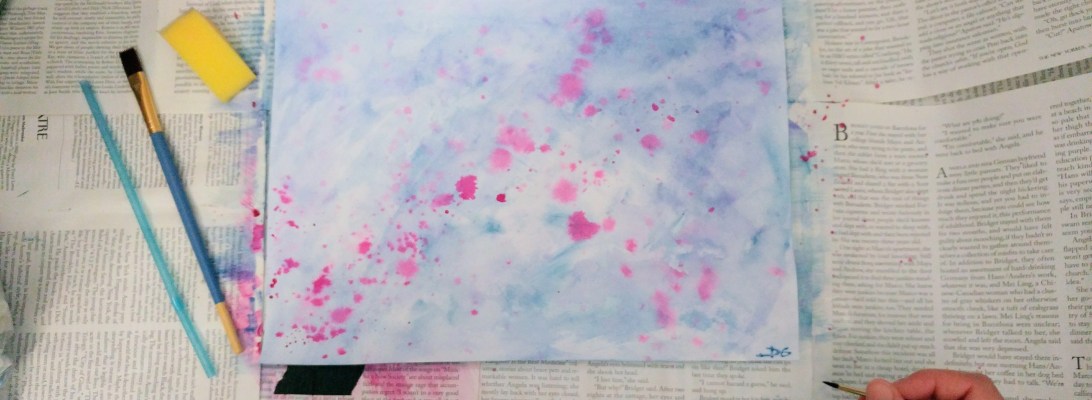
First, I wet the page to create gloomy yet light clouds using blue and purple hues. Once the cloudy background was dry, I was eager to try to splatter the paint to replicate rain drops. I picked a bright pink colour to hint at spring blooms, and got started with a tiny brush. Then I grabbed a larger brush to create more depth and movement on the page. The watercolours perfectly captured April Showers.

April Showers.jpg

Sunset Drive Blow Painting

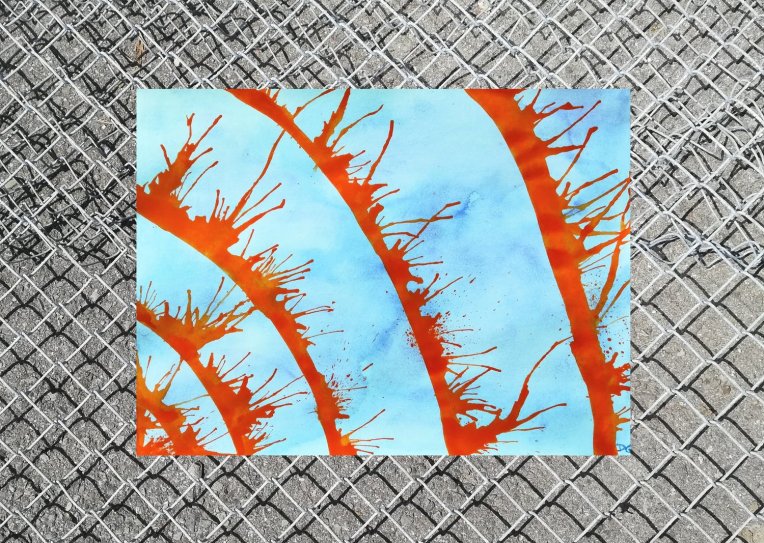
Later that week it rained again, only this time I was in a car. The experience felt completely different with the wipers pushing the rain across the windshield. It seemed impossible to replicate until I was reminded of the straw blowing technique. By combining the watercolour with a ridiculous amount of water, you’re able to quickly spread a paint drop with a straw before it dries. Once again, I painted a cloudy spring background as the first layer. Then I mixed colours to create a vibrant orange to represent the rain on a Sunset Drive.

Sunset_Drive_Danielle_Geva_Art

Photographing Watercolours

When photographing April Showers for my shop, I walked around Toronto’s waterfront. My intention was to find a shady and green spot, but the painting looked best against a fairly sunny concrete step. I liked how the step seemed to have been affected by the elements, and decided my search was over.

Next I kept an eye out for a good location to photograph Sunset Drive. I looked around for a spot by the highway, but it felt it would distract from the painting. As I was walking home, I noticed a wire fence on the ground of a parking lot. I didn’t know if it was about to be put up or taken away, so I quickly snapped a few pictures. Even though I didn’t have the painting with me, I knew it would make for the perfect backdrop.

If the artwork looks like it’s floating above the fence, now you know why. One thing that helped combine the two images was flattening the painting before photographing it. Even with painters tape, the paper had warped a bit with the amount of water I had used. A large stack of books helped solve the issue, and glassine paper kept the painting protected.

It was definitely worth experimenting with watercolours, and I can’t wait to paint with them again. In the meantime, both April Showers and Sunset Drive are available for sale in the shop.

Enjoyed this post? Subscribe here!